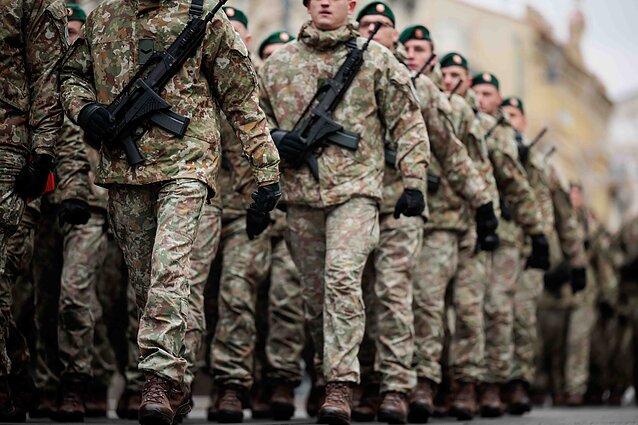






Earlier this year, Europe’s defence and space commissioner, Andrius Kubilius, floated the idea of “a powerful, permanent European military force of 100,000 troops”. In his view, such a force could help better protect the European continent.
“How will we replace the permanent presence of 100,000 US troops, which form the backbone of Europe’s defence?” he asked in a speech in Sweden.
The proposal from Kubilius came at a time when concerns among NATO allies were growing over Washington’s reliability, following remarks by US President Donald Trump about wanting to take control of Greenland. Trump has since repeatedly cast doubt on NATO’s future, while criticising some European partners.
Lithuanian officials have historically been skeptical of military structures alternatives to NATO, mainly because VIlnius saw the US as its main security guarantor.
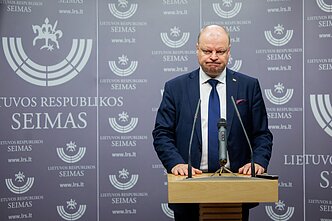
However, the current chair of the Lithuanian parliament’s Committee on National Security and Defence, Rimantas Sinkevičius, struck a somewhat different tone.
“It seems to me the idea is worth considering,” he said, adding that NATO is essentially a treaty and that there is no such thing as a single “NATO army”.
He suggested the idea could only be realised in the distant future. According to Sinkevičius, the European Union currently has relatively small armed forces, which “would struggle to address a larger-scale conflict”.

“A force of 100,000 troops would be something significant. But on the other hand, there would be many bureaucratic challenges – command structures, maintenance costs, troop numbers and so on,” he said.
He added that creating a joint EU army would face major bureaucratic hurdles, as well as legal and practical constraints.
“The level of bureaucracy within the European Union when it comes to decision-making, the principle of unanimity and so on, all require extensive preparatory work. I am not sure how realistic this would be,” he said.
In his view, any discussion of a European army would also require a broader rethink of the EU’s future: “Do we keep the European Union as it is, where different states are united but retain a degree of autonomy?”
Former defence minister Laurynas Kasčiūnas raised further questions, including where the proposed 100,000 troops would come from.
“These troops are already assigned by European NATO countries to defence plans. So would we be pulling them out of NATO plans? Or would these be new forces?
“Unfortunately, generating new forces in Europe is not easy, for various reasons: the absence of conscription in some countries, neglected reserves, and a range of other structural problems,” he said.
Risk of duplicating NATO?
Kasčiūnas, now deputy chair of the parliamentary committee, said he supports strengthening Europe’s military power – but only within NATO.
“I support reinforcing the European pillar and Europe’s military capabilities within NATO. But the key condition is that it must be within NATO.
“We need to develop critical weapons systems and strengthen capabilities where we currently depend on the United States and reducing that dependency. This includes intelligence, long-range strike capabilities and ballistic missile defence.

“We should strengthen these areas, as well as other conventional capabilities, but not create alternative structures that duplicate NATO,” he said.
Kasčiūnas pointed to NATO defence plans, which set out the forces each member state is expected to contribute.
“If countries have capabilities beyond what is required for NATO plans, and can use those to build a separate EU force, then that is fine.
“Why not? But it is very likely that forces would have to be taken out of NATO plans and integrated into a European framework. That is where duplication arises,” he said.
Joint procurement already under way
One area where European countries are already co-operating is defence procurement. Mr Sinkevičius highlighted the so-called SAFE programme, which allocates €150bn for military purchases.
“Member states can apply for these concessional loans, which are not counted as part of national debt. However, this does not cover the whole of NATO – it is mainly for EU countries.
“SAFE also foresees co-operation in purchasing military equipment, allowing larger quantities to be bought at lower cost,” he said.
Kasčiūnas agreed that joint procurement is a direction that should be pursued further.
“A common defence market is important, where we do not restrict ourselves with national limitations, but pool resources regionally and purchase equipment together.
“It matters that we have similar infantry fighting vehicles, similar air defence systems and so on. There is significant scope here for expanding European defence,” he said.
On Tuesday, the Wall Street Journal reported that European countries were implementing a contingency plan to use existing NATO military structures in case the US withdrew from the alliance.
The plan, referred to as “European NATO” by some, is gaining momentum after receiving support from Germany, WSJ wrote.
These plans are being informally discussed at and around NATO headquarters and are not intended to compete with the existing allied structures.

Newsletter
Every Friday morning.